What is a paid stock promotion?
A paid stock promotion is an ad for a stock: someone pays a newsletter or site to publish a ticker. How it works, why it's legal, and what the disclosure tells you.
- Reading time
- 5 min read
- Published
- Sections
- 7 sections
On this pageWhat a paid promotion looks like from your inbox
A paid stock promotion is an advertisement for a stock. Someone pays a newsletter, a website, a social media account or a video channel to put a specific ticker in front of its audience, usually over a set number of days. The content reads like research or a hot tip. The money behind it is what makes it an ad.
That's the whole definition. Everything else in this guide is about how the arrangement works, why it's allowed, and what you can learn from the paperwork it leaves behind.
What a paid promotion looks like from your inbox
Most traders meet their first one without knowing it. An email lands from a newsletter you signed up for years ago, or one you don't remember signing up for at all. It's excited about a company you've never heard of: small, cheap per share, and apparently on the edge of something. There's a catalyst, a sector story, and a reason today matters.
The same pattern shows up on investing websites, in sponsored articles, in text messages, on social media, and in short videos. The format changes. The structure doesn't: a third party has been paid to publish a named stock to an audience on specific dates.
None of that tells you the company is bad, or that the stock will fall. It tells you that the attention arriving on that ticker was bought, which is a fact worth knowing before you act on it.
Why paid stock promotion is legal
You can be paid to promote a stock. You just have to say so.
Paying for publicity is ordinary commerce. Companies buy ads for their products all the time, and buying attention for their stock isn't banned either. What the law cares about is that the reader knows they're looking at a paid message.
In the US, the key rule is Section 17(b) of the Securities Act of 1933, often called the anti-touting provision. It makes it unlawful to publish something that describes a security in exchange for payment from an issuer, underwriter or dealer without fully disclosing that you were paid and how much. You can be paid to promote a stock. You just have to say so.
What turns a promotion into a fraud case isn't the payment. It's things like hiding the compensation, making false claims about the company, or secretly selling into the buying the campaign creates while telling readers to buy. Those cases get brought. The plain, disclosed version is a large and ordinary business that runs every trading day.
The disclosure: the part almost nobody reads
Because the payment has to be disclosed, nearly every compliant promotion leaves a written record. It usually lives in two places: a disclaimer page on the publisher's website, and a block of fine print at the bottom of the email or article.
A typical disclosure tells you:
- the ticker being promoted;
- how much the publisher was paid, or will be;
- who paid, and often on whose behalf;
- the dates the campaign runs;
- whether the paying party, or the publisher, may hold or sell shares.
Anatomy of a disclosure
This newsletter is a paid advertisement. Example Newsletter is owned by Sample Publishing LLC. Sample Publishing LLC has been compensated fifty thousand dollars ($50,000) by Placeholder Media Inc. on behalf of a third party for a three-day advertising campaign covering XXXX, beginning on the 6th and ending on the 8th of this month. Placeholder Media Inc. and its affiliates may hold shares of XXXX and may sell those shares at any time, including during this campaign. We do not hold a position in XXXX. This is not investment advice.
- The labelIt's an ad, not independent research.
- The publisherThe business behind the brand in your inbox.
- The amountThis list's fee. Don't add it up across lists.
- Who paidThe payer, and whose money it really is.
- Ticker and windowWhat's advertised, and on which dates.
- May sell sharesThe payer may be selling into the demand.
- Position and adviceThe publisher's own stake, and the usual caveat.
Each of those fields means something specific, and a few of them are routinely misread. Our field-by-field guide to reading a disclaimer walks through them with an illustrative example.
Who's involved
A small promotion can be one company paying one newsletter. Bigger campaigns usually have layers:
- The funder, where the money ultimately comes from: the company itself, a shareholder, or a third party.
- The operator, a marketing or media firm that takes the funder's budget and buys placements.
- The promoters, the newsletters and sites that publish the ticker to their lists.
Who pays whom
The company, a shareholder or a third party. Where the budget starts.
A media or marketing firm that takes the budget and buys placements.
Many lists, each paid its own fee, each stating it in a disclaimer.
Your inbox: the same ticker, from several senders, on the same morning.
IR firms usually sit beside this chain: they handle a company's own investor communications. One that pays third parties to publish the ticker is acting as an operator, whatever it calls itself.
That layering is why one funded decision can look like several independent opinions arriving on the same morning. We break the roles down in who pays whom in a stock promotion, and you can browse the operators named in real disclosures on the operators index.
Why a company, or anyone else, pays for it
"The company wants more shareholders" is part of the answer. A campaign can also buy two things a small company finds hard to get on its own: a higher share price and trading volume.
Volume matters more than people expect. A company with an at-the-market offering or an equity line can only sell new shares into the market as fast as there are buyers to absorb them. Holders of warrants or convertible notes need liquidity to exit. A stock that normally trades a few hundred thousand shares a day is hard to sell into; the same stock trading many times that is not. None of that is hidden, since offerings and warrant terms are public filings, but it's often the most honest answer to "why would anyone pay for this?" Our red flags checklist covers what to look for in those filings.
What usually happens to the stock
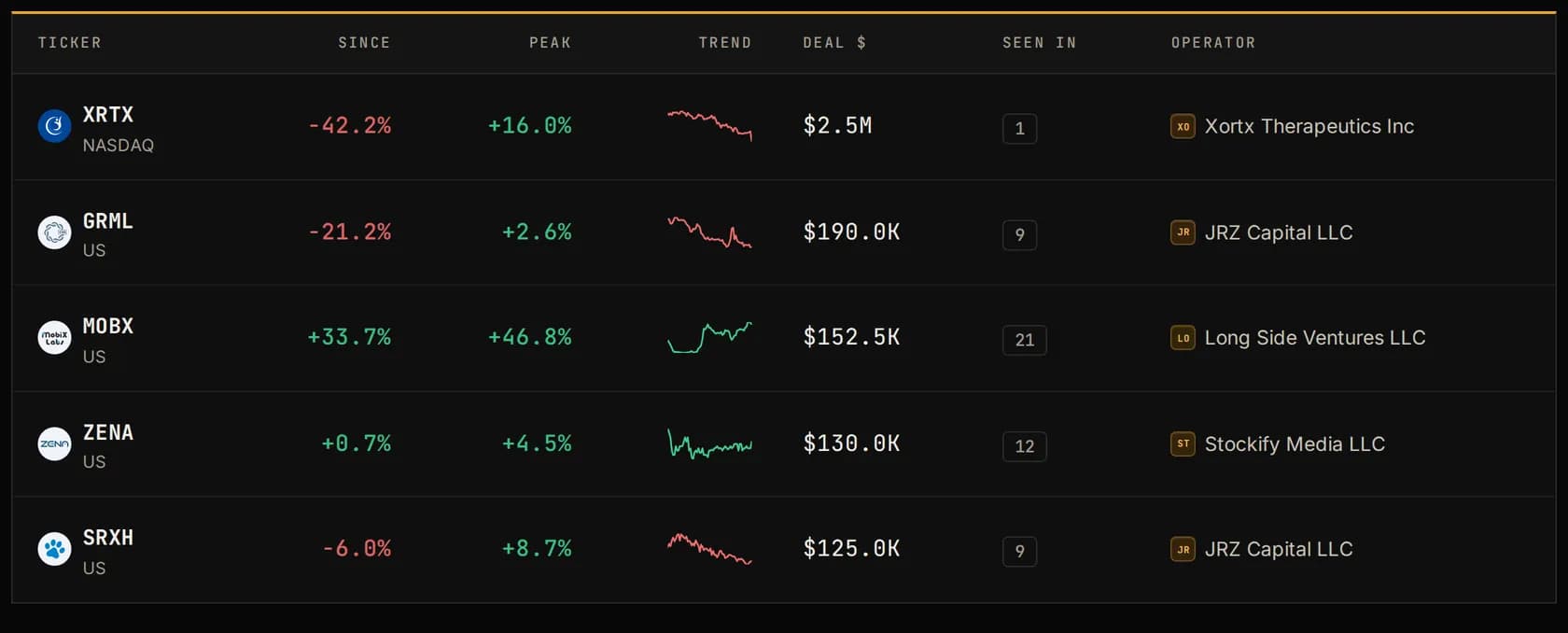
Promoted stocks tend to be small and thinly traded, so a burst of attention can move the price a long way, quickly. What happens after the paid attention stops is the more important question, and it's one you can answer with data rather than anecdotes. We measure every disclosed deal we track from the first tradable print after the disclosure through the end of its window, and summarize the results in what happens to a stock after a paid promotion.
Where to see paid promotions as they're disclosed
You can find disclosures by hand: take the sender's domain, add /disclaimer, and read the row for the ticker. Doing that across hundreds of publishers is the tedious part, and it's what we do for you. Every ticker with a disclosed promotion has a public page in the promoted tickers index, and the methodology explains how we collect and dedupe them.
Common questions
Is paid stock promotion legal?
Yes, when it's disclosed. Section 17(b) of the Securities Act requires anyone paid by an issuer, underwriter or dealer to describe a security to disclose that payment and its amount. A disclosed promotion is legal; hiding the payment, or lying about the company, is not.
Does a paid promotion mean the company is a bad investment?
Not by itself. It means the attention on the stock was paid for. The SEC does warn that heavily promoted, thinly traded stocks carry extra risk, and that a disclosure may not reveal everything about who is behind the money, so it's a reason to research harder, not a verdict.
How much does a stock promotion cost?
It varies widely. Disclosed figures range from a few thousand dollars for a single placement to large multi-newsletter budgets. Each newsletter usually discloses its own fee, so adding up every newsletter's number double counts the same campaign.
Educational content only. Nothing here is investment advice, a recommendation to buy or sell any security, or a prediction about any stock. paidpromotracker reports disclosed public information and doesn't evaluate the merits of any company or campaign. See the full disclaimer.