Stock promoters, newsletters, IR firms and operators: who pays whom
Who's who in a paid stock promotion: the funder, the operator that hires the lists, the newsletters that publish, and IR firms. How the money flows and why it matters.
- Reading time
- 5 min read
- Published
- Sections
- 7 sections
On this pageThe chain, from money to message
"Stock promoter" gets used for anyone who talks up a stock, but in a paid campaign it's a specific job in a chain of specific jobs. Money starts with someone who wants attention on a ticker and passes through one or more hands before a newsletter hits send. Each hand is a different kind of business, with different incentives, and the disclosure usually names some of them but not all.
Knowing who sits where in that chain is the difference between reading a disclosure and understanding it.
The chain, from money to message
A fully layered campaign looks like this:
The chain
The company, a shareholder or a third party. Where the budget starts.
A media or marketing firm that takes the budget and buys placements.
Many lists, each paid its own fee, each stating it in a disclaimer.
Your inbox: the same ticker, from several senders, on the same morning.
IR firms usually sit beside this chain: they handle a company's own investor communications. One that pays third parties to publish the ticker is acting as an operator, whatever it calls itself.
- The funder puts up the budget. It might be the company itself, a large shareholder, a financier holding warrants or notes, or a third party with no obvious link to the company at all.
- The operator (sometimes called an agency, a marketing firm or a media company) takes that budget and buys placements. It's the "paid by" name you'll see on most disclosures.
- The publisher is the media business that owns one or more newsletters or sites.
- The newsletter is the list that actually emails you. One publisher often runs several of them under different names.
Small campaigns skip layers: a company might pay one newsletter directly. Large ones can add more, with an operator subcontracting part of a budget to another operator.
Operators: the middle of the chain
Operators are where campaigns are actually organized. They hold the relationship with the funder, choose which lists to buy, set the schedule and pay each publisher its share. The disclosure on a newsletter's page usually names the operator as the party that paid it, sometimes adding "on behalf of" another name.
This layer is much more concentrated than the newsletter layer. A small number of operators sit behind a large share of all disclosed campaigns, so when a dozen newsletters run the same ticker on the same morning, it's very often one operator's campaign, and often the same operator you saw the week before.
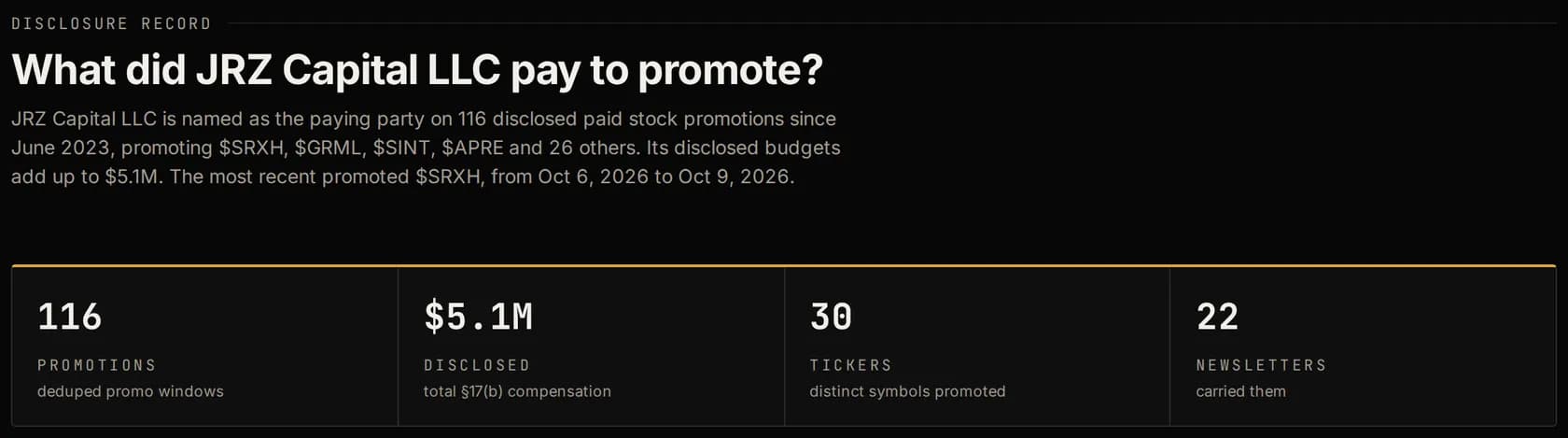
That's why we group and grade deals by operator. You can browse every operator named in the disclosures we track on the operators index, and each operator's page lists the tickers it has paid to promote.
Funders: where the money really comes from
If the funder holds the stock being advertised, the campaign and the exit can be the same event.
The funder is the hardest party to see. Disclosures often name the operator and stop, or say "on behalf of" a company name that tells you little about who stands behind it.
It matters because the funder's incentive defines the campaign. An issuer might want awareness ahead of a financing. A shareholder might want buyers for shares it plans to sell. The SEC's investor alerts make the point directly: a disclosure may not reveal that the underlying source of the money is a company insider or affiliate. If the funder holds the stock being advertised, the campaign and the exit can be the same event.
We record the funder separately from the deal itself (see funder), because the same campaign is often disclosed with the funder named on some newsletters and left blank on others.
IR firms: not the same thing, but sometimes nearby
Investor relations (IR) firms are a normal part of being a public company. They organize earnings calls, investor conferences and shareholder communications, help write press releases, and arrange meetings with analysts and funds. Plenty of IR work has nothing to do with paid promotion.
The overlap comes at the small end of the market, where some firms that describe themselves as IR or "investor awareness" agencies also buy newsletter placements, sponsored articles or social media campaigns for their clients. When they do, the same disclosure rules apply to whoever publishes the paid content. A useful test: is the firm communicating on the company's behalf in its own name, or paying third parties to publish the ticker to their audiences? The second one is a paid promotion, whatever the firm calls itself.
How each party gets paid
Cash is common, and it's the figure most disclosures state. Shares are the other currency: a promoter or operator may be paid in stock, or the funder may already hold shares. When a disclosure says the paying party "may hold shares and may sell them at any time," it's describing exactly that possibility.
Payment in stock changes the economics. A promoter paid in cash has been paid whatever happens. A party holding the shares being advertised does better if it can sell them into the attention the campaign creates.
Why the chain matters to a trader
For the legal side of who must disclose what, read Section 17(b) explained.
Common questions
What is a stock promoter?
A stock promoter is a person or business paid to publish or publicize a specific stock to an audience, most often through an email newsletter, website or social media account. In a disclosed campaign, the promoter states that it was compensated, by whom and how much.
Is an investor relations firm a stock promoter?
Not necessarily. Investor relations is a standard corporate function. A firm crosses into paid promotion when it pays third parties, such as newsletters, to publish the stock to their audiences.
What's the difference between an operator and a promoter?
On this site, the promoter is the newsletter or site that was paid to publish the stock, and the operator is the party the disclosure names as having paid it. One operator typically buys space on many promoters for a single campaign.
Educational content only. Nothing here is investment advice, a recommendation to buy or sell any security, or a prediction about any stock. paidpromotracker reports disclosed public information and doesn't evaluate the merits of any company or campaign. See the full disclaimer.