How to tell if a stock is being paid to be promoted
How to check whether a stock is being paid to be promoted: where the disclaimers live, the words to search for, and the market signs that show up alongside a campaign.
- Reading time
- 4 min read
- Published
- Sections
- 6 sections
On this pageStep 1: read the bottom of the message
If a stock you've never heard of is suddenly in your inbox, your feed and your watchlist alerts all at once, it's fair to ask whether that attention was paid for. Usually you can find out. Paid promotions that follow the rules have to disclose the payment, and that disclosure is public. The trick is knowing where it lives and what it looks like.
This guide covers the three ways to check: read the message itself, find the publisher's disclaimer page, and look for the market patterns that tend to travel with a campaign.
Step 1: read the bottom of the message
Scroll past the sign-off and the unsubscribe link. Promotional emails almost always end with a long block of small grey text, and the compensation language is somewhere in it. Search the email for these words:
A compliant disclosure names the ticker and a dollar amount. Often it names the party that paid and the dates of the campaign too. If you find one, you've confirmed the promotion, and the details are worth reading closely. Our guide to reading a stock promotion disclaimer explains each field.
On websites and sponsored articles, look for a "sponsored" label near the headline and a disclosure paragraph at the end. On social media, look for #ad, "paid partnership" labels, or a link to a disclosure page in the profile.
Text messages and short videos are the hardest to check, because there's rarely room for fine print. If a text or a clip pushes a specific small stock, look for a link back to a website, then find that site's disclaimer page. No link and no disclosure is a reason to be more careful, not less.
Step 2: find the publisher's disclaimer page
Most promotional newsletters keep a standing page listing their current and recent paid campaigns. It's usually the most complete record you'll find, because it's what the publisher points to as its disclosure. Try the sender's domain followed by:
- /disclaimer
- /disclosure or /disclosures
- /legal or /terms
You can also follow the "disclaimer" link in the email's footer. Once you're there, search the page for the ticker. A row will typically list the amount, the paying party and the campaign dates.
Step 3: check a record that's already done the matching
Reading one publisher's page tells you about one list. The useful question is usually bigger: how many lists are running this ticker right now, and who's paying for all of them? Answering that by hand means visiting every disclaimer page and matching rows by ticker and date.
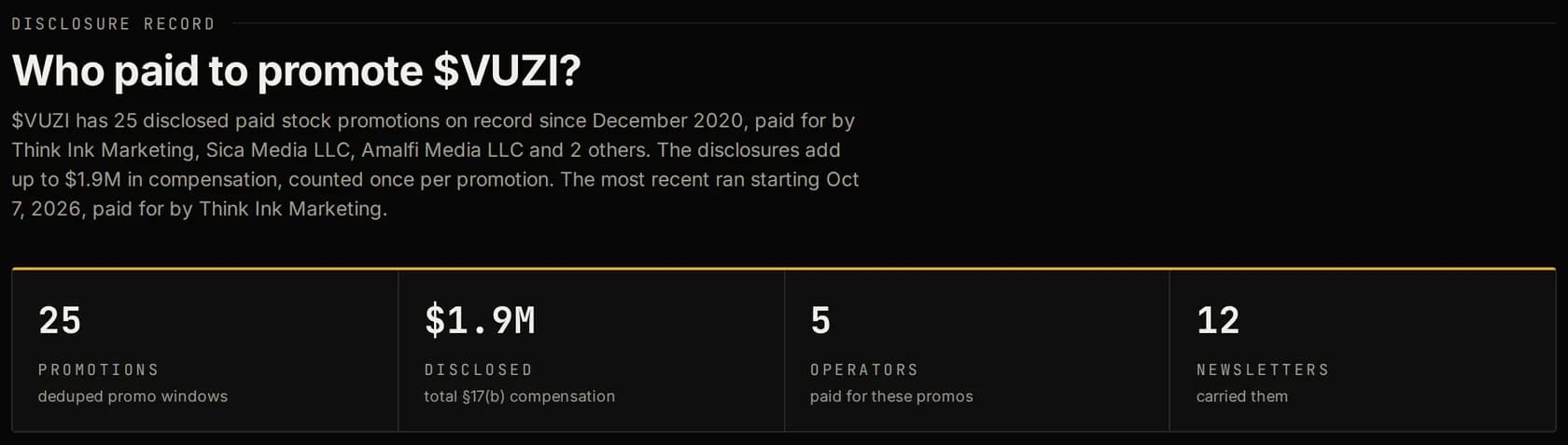
That's the work this site does. Look the symbol up in the promoted tickers index; each ticker's page lists every disclosed promotion we've recorded for it, with the paying party and the window. The operators index shows the same thing from the other direction: everything a given paying party has funded.
Market signs that often travel with a campaign
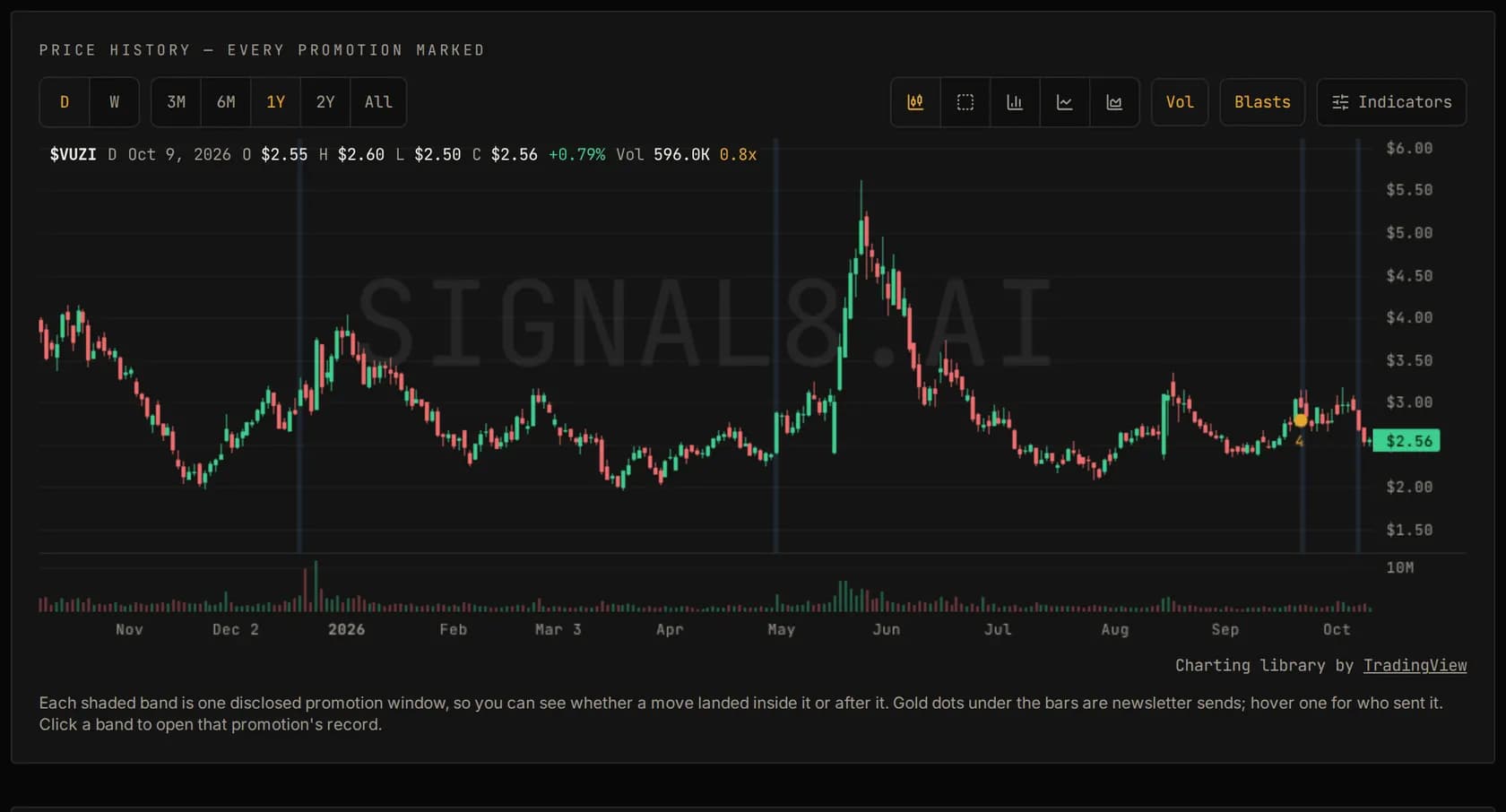
None of these prove a stock is being promoted on its own. Together, they're a good reason to go looking for a disclosure:
- Volume far above normal in a stock that usually barely trades, especially before the market opens.
- Several unrelated-looking newsletters featuring the same small company on the same evening or morning.
- Urgent, time-boxed language: "before the bell", "topping our watchlist tomorrow", "don't miss this one".
- More promotion of the stock than of the product. The SEC's own investor alerts flag this one specifically.
- A press release with no obvious substance arriving alongside the coverage.
When you can't find a disclosure
If something reads like a promotion but you can't find any compensation language, be more careful, not less. The SEC's guidance on newsletters is blunt: be suspicious of a newsletter that doesn't disclose being paid, and skeptical of vague language like "we may receive compensation from companies we write about" that names no payer and no amount.
The SEC also points out that a disclosure can be technically present and still incomplete: it may not reveal that the money ultimately came from a company insider. Treat a disclosure as the start of your research, not the end of it. The SEC's investor alerts on fraudulent stock promotions and on investment newsletters are linked from our methodology sources.
Once you know it's promoted
Knowing a stock is promoted changes the questions worth asking. How big is the campaign? How many lists are running it? When does the window end? Does the company have an open offering that the volume would help? Our research guide to paid promotions goes through each one, and the red flags checklist covers the filings.
Common questions
Where do stock promoters put their disclaimer?
Usually in two places: a standing disclaimer or disclosure page on the publisher's website (often at /disclaimer), and a block of fine print at the bottom of each promotional email or article.
Is every heavily hyped small-cap stock a paid promotion?
No. Stocks get attention for real news, for social media momentum and for plenty of other reasons. A paid promotion is specifically one where someone was compensated to publish the stock, and the way to confirm it is to find the compensation disclosure.
What if I can't find any disclosure?
The SEC advises suspicion toward any newsletter that doesn't disclose compensation, and skepticism toward vague disclosures that name no payer or amount. An undisclosed paid promotion is exactly what Section 17(b) prohibits.
Educational content only. Nothing here is investment advice, a recommendation to buy or sell any security, or a prediction about any stock. paidpromotracker reports disclosed public information and doesn't evaluate the merits of any company or campaign. See the full disclaimer.