How to read a stock promotion disclaimer
A field-by-field walkthrough of a stock promotion disclaimer: the ticker, the amount, who paid, the dates, and the share-selling line most readers skip.
- Reading time
- 5 min read
- Published
- Sections
- 10 sections
On this pageAn illustrative disclaimer
- An illustrative disclaimer
- This newsletter is a paid advertisement
- The publisher and the newsletter
- The amount
- Who paid: "by" and "on behalf of"
- The ticker
- The dates (the campaign window)
- May hold shares and may sell those shares at any time
- We do not hold a position" and "not investment advice
- What a weak disclaimer looks like
- Common questions
A stock promotion disclaimer is the paragraph a paid publisher adds to satisfy the disclosure rules. It's dull on purpose and placed where you'll skip it. Read slowly, though, it's one of the most informative documents in small-cap trading: it tells you, in advance and in writing, who paid to put a stock in front of you, how much, and for how long.
Below is an illustrative disclaimer. The names, ticker and figures are invented, but the structure matches what real disclosures say. We'll go through it one field at a time.
An illustrative disclaimer
This newsletter is a paid advertisement. Example Newsletter is owned by Sample Publishing LLC. Sample Publishing LLC has been compensated fifty thousand dollars ($50,000) by Placeholder Media Inc. on behalf of a third party for a three-day advertising campaign covering XXXX, beginning on the 6th and ending on the 8th of this month. Placeholder Media Inc. and its affiliates may hold shares of XXXX and may sell those shares at any time, including during this campaign. We do not hold a position in XXXX. This is not investment advice.
- The labelIt's an ad, not independent research.
- The publisherThe business behind the brand in your inbox.
- The amountThis list's fee. Don't add it up across lists.
- Who paidThe payer, and whose money it really is.
- Ticker and windowWhat's advertised, and on which dates.
- May sell sharesThe payer may be selling into the demand.
- Position and adviceThe publisher's own stake, and the usual caveat.
Real disclaimers vary in wording and order, and many omit one or more of these fields. When a field is missing, that absence is information too.
"This newsletter is a paid advertisement"
The label. It's the publisher telling you that what you just read is an ad, not independent research. Some disclaimers bury this further down; some put it in the subject line. Wherever it appears, it reclassifies everything above it.
The publisher and the newsletter
"Example Newsletter is owned by Sample Publishing LLC." The newsletter is the brand in your inbox. The publisher is the company that owns it and receives the money. One publisher often runs several newsletters, so two lists with different names can be the same business.
On this site the publisher side is called the promoter.
The amount
"Compensated fifty thousand dollars ($50,000)." This is the most useful number on the page. Section 17(b) requires the amount to be disclosed, and it gives you a rough sense of what the campaign is worth to whoever is paying.
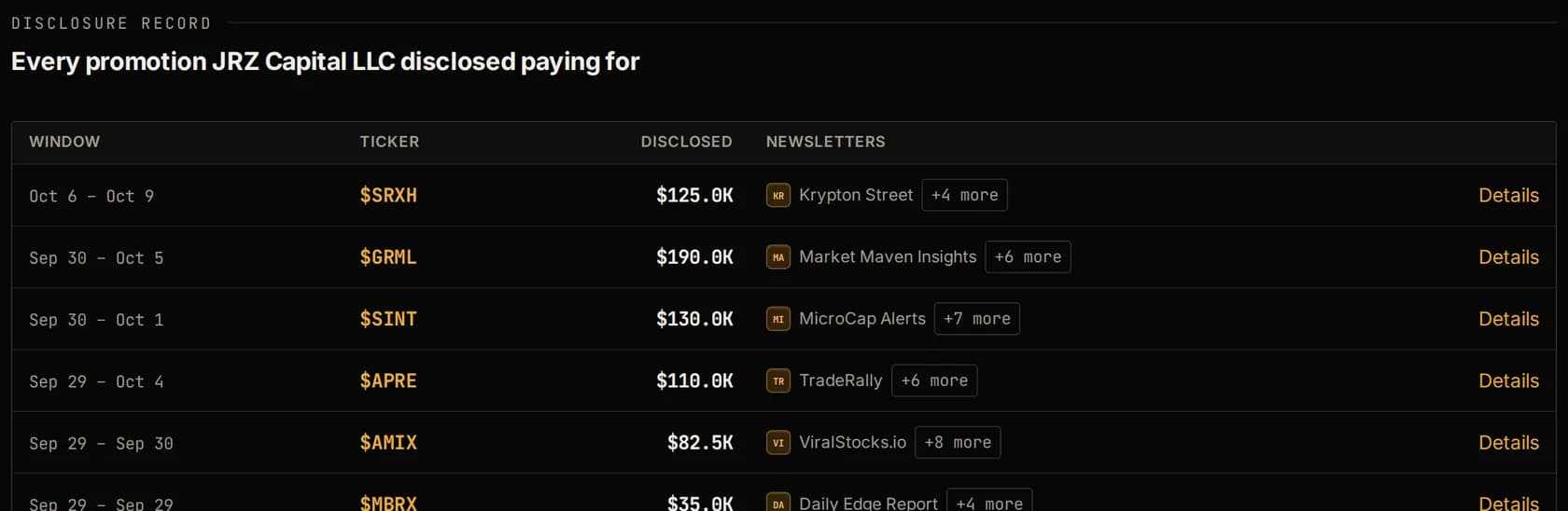
Watch the tense as well. "Has been compensated" and "expects to be compensated" are both disclosures; the rule covers payments received or to be received. And watch the currency: payment in shares should be described as shares.
Who paid: "by" and "on behalf of"
"By Placeholder Media Inc. on behalf of a third party." Two names live here. The first is the party that paid the publisher, usually a marketing firm we call the operator. The second, after "on behalf of", is supposed to point further up the chain toward the funder.
"A third party" with no name is common and tells you very little. Courts have disagreed about how far the disclosure rule requires the source of the money to be named, and the SEC warns that a disclosure may not reveal that the money ultimately came from an insider. When the funder is vague, assume you don't know who's behind the campaign. Our guide to who pays whom explains the layers.
The ticker
"Covering XXXX." Confirm the symbol and the market it trades on. Promoted stocks are often small, low-priced and sometimes quoted over the counter rather than listed on an exchange, which matters for how easily the price moves and how easily you can sell. Every symbol with a disclosed promotion in our record has a page in the promoted tickers index, with every campaign we've seen for it.
The dates (the campaign window)
"A three-day advertising campaign... beginning on the 6th and ending on the 8th." This is the promotion window: the period the publisher is paid to cover the stock. It's a rare thing in markets, a scheduled, documented, forward-dated event.
- A missing end date means unknown, not "forever".
- The start date isn't when you found out. Disclosures often go up in the evening for a window that starts that same calendar day, so measuring from the window start can count trading that happened before the disclosure existed. We measure from the first tradable print after the disclosure.
- The end date isn't a prediction that the stock falls. It's the date after which nobody is being paid to talk about it.
"We do not hold a position" and "not investment advice"
The publisher's own position statement and its advice disclaimer. "We do not hold a position" applies to the publisher, not to the paying party named a sentence earlier. "Not investment advice" and "not a registered investment adviser" mean the publisher is disclaiming the duties an adviser would owe you.
What a weak disclaimer looks like
The SEC gives examples of disclosures that should make you skeptical because they say nothing specific, such as "from time to time, we may receive compensation from companies we write about." No ticker, no payer, no amount. Compare that with the fields above: a specific disclosure names all of them.
For the rule behind all this, read Section 17(b) explained for traders.
Common questions
What does a stock promotion disclaimer have to say?
Under Section 17(b), someone paid by an issuer, underwriter or dealer to describe a security must fully disclose that they received (or will receive) payment and the amount. Most disclaimers also name the paying party, the dates and whether the payer may sell shares.
Why do different newsletters disclose different amounts for the same stock?
Each newsletter discloses its own fee for its slice of the campaign, and some disclose the overall budget. Adding every newsletter's figure together overstates the campaign.
What does "on behalf of a third party" mean?
It means the party that paid the publisher was itself acting for someone else, the ultimate funder, who isn't named. It tells you there's another layer in the chain without telling you who it is.
Educational content only. Nothing here is investment advice, a recommendation to buy or sell any security, or a prediction about any stock. paidpromotracker reports disclosed public information and doesn't evaluate the merits of any company or campaign. See the full disclaimer.